

Disaster recovery has traditionally been something only well-funded broadcasters could afford to do properly: a second site, duplicate hardware sitting mostly idle, and enough engineering headcount to keep both in sync. For a startup TV channel or a lean broadcaster building out its first few channels, that price tag usually means DR gets deferred — a risk accepted rather than a plan put in place. Cosmos, PlayBox Technology’s cloud-native playout platform, is built around an architecture that changes that calculation, because the same properties that make it a fast, affordable way to launch a channel also make it a practical way to protect one.
Why disaster recovery is really an orchestration problem
At its core, broadcast disaster recovery isn’t about buying a second server — it’s about making sure a channel’s schedule, content, and playout logic can come back on air somewhere else quickly, correctly, and without an operator having to rebuild it from memory under pressure. That’s fundamentally a media orchestration problem: the same coordination between ingest, scheduling, playout, and delivery that runs a channel day to day is what needs to survive a site going down, a connectivity failure, or a hardware fault.
Traditional playout infrastructure struggles here because recovery often means physically standing up equivalent hardware somewhere else, then re-establishing the same configuration on it — a process that takes time a live channel doesn’t have. Cloud-native, orchestration-first architecture approaches this differently: if the platform is already deployable across environments, recovery is a matter of running the same software elsewhere, not building a duplicate facility.
How Cosmos’s architecture supports this
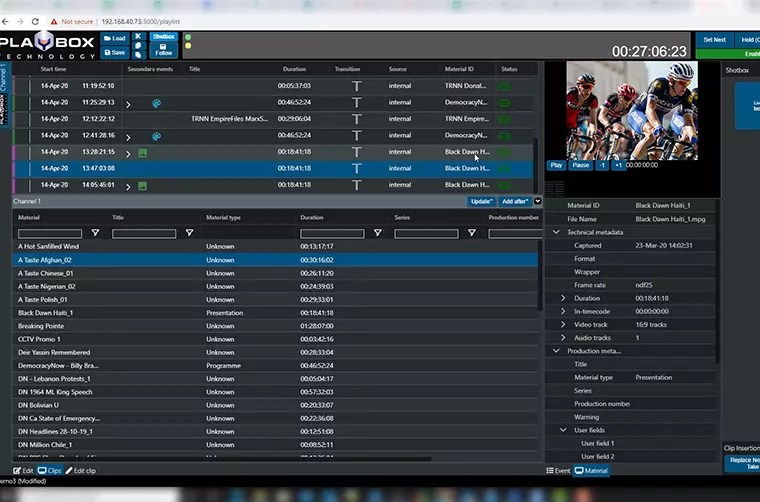
Cosmos is built as a microservices-based, distributed, virtualised playout engine, explicitly designed for resilience and scalability rather than as a single monolithic application tied to one machine. It’s deployable in public cloud, private cloud, or hybrid configurations, which means a broadcaster’s channel isn’t inherently anchored to one physical location the way a traditional hardware-based playout server is. Channel management runs from a standard enterprise workstation over a secure internet connection, with web-based management for remote control — the same properties that let an operator run a channel from anywhere also let a second team, or the same team, bring a channel back up from a different location without needing to be physically present at a specific facility.
Because Cosmos integrates with third-party MAM, CMS, and traffic systems via API rather than requiring content and schedules to live only inside a closed local system, recovery doesn’t depend on physical media surviving a single-site failure. Scheduling and content references can be re-pointed to wherever the underlying assets and platform instance are running.
It’s worth being precise about what this means in practice: Cosmos’s architecture is built to support multi-site and multi-cloud deployment patterns, which is the foundation disaster recovery depends on. Broadcasters evaluating it specifically for DR should confirm directly with PlayBox what recovery time and recovery point objectives look like for their intended configuration, since those numbers depend on how a given deployment is set up rather than being a fixed property of the software alone.
Centralized control across sites
For a startup broadcaster running more than one channel, or a broadcast operations leader overseeing channels in more than one region, DR and day-to-day multi-site management are really the same capability viewed from different angles. A platform that centralizes scheduling, monitoring, and playout control across sites for everyday operations is, by definition, also positioned to redirect that control to a healthy site when one location has a problem. This is where the cost of building genuine DR capability drops the most for a smaller broadcaster: the centralized control needed to run three channels across two regions efficiently is largely the same capability needed to fail one of them over if a site goes down.
Why this matters specifically for affordability
PlayBox Technology has a long history in exactly this space — Atlanta-based post-production and broadcast facility Crawford Communications, for example, expanded its disaster recovery capability specifically because it needed a lower-cost redundant playout solution than the alternatives it evaluated, building on PlayBox’s AirBox playout line. Cosmos extends that same cost-conscious philosophy into a cloud-native model: a pay-as-you-grow SaaS deployment approach means a startup broadcaster isn’t paying to keep duplicate hardware running idle at a second site just in case, and isn’t required to make a large capital investment before it knows whether a channel will succeed.
For a broadcaster weighing disaster recovery against every other line item in a limited budget, that difference — infrastructure you scale into rather than infrastructure you buy up front — is often what makes DR planning realistic rather than aspirational.
Practical guidance for smaller broadcast operators
- Treat DR as a configuration decision, not a separate purchase. If the underlying platform already supports multi-cloud or hybrid deployment, ask what it takes to configure a second running instance rather than assuming DR means new infrastructure.
- Get specific recovery time numbers before you need them. “Cloud-native” and “resilient” are architectural properties, not guarantees — confirm actual recovery time and recovery point objectives for your specific deployment.
- Make sure content, not just configuration, survives a failure. Playout logic recovering quickly doesn’t help if the media it needs to play isn’t accessible from wherever the platform comes back up — check how archive and asset access are handled in a failover scenario.
- Test the failover, don’t just plan it. A DR plan that’s never been exercised is a hypothesis, not a capability.
Where this leaves the decision
For a startup channel or a lean broadcast team, the appeal of Cosmos for disaster recovery isn’t a single DR-specific feature — it’s that the same cloud-native, orchestration-first architecture built to make launching a channel fast and affordable also happens to make protecting one fast and affordable. That’s a more useful way to evaluate media orchestration platforms generally for a smaller operator: not “does this vendor sell a disaster recovery product,” but “is the platform built so that resilience is a natural extension of how it already runs, rather than a separate system to bolt on later.”
