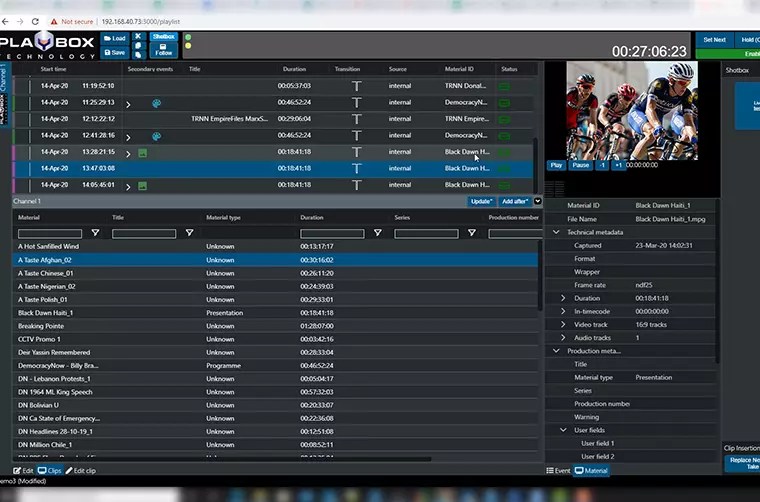
Connect Broadcast Workflow Orchestration With Existing TV Playout
National broadcasters rarely have the luxury of replacing every system in their broadcast operation. Existing playout automation, media asset management, scheduling, ingest and transmission infrastructure often need to continue operating reliably while new workflows are introduced around them.
Cosmos provides a workflow orchestration layer that helps broadcasters connect these environments, coordinate media operations and integrate existing TV playout automation into a more unified workflow.
Instead of forcing broadcasters to rip and replace proven systems, Cosmos helps bring disconnected processes together so teams can manage complex broadcast operations with greater visibility and control.
The result: integrated playout workflows without unnecessary disruption to on-air operations.
What Is Cosmos?
Cosmos is a broadcast workflow orchestration platform designed to coordinate media workflows across hybrid and multi-system broadcast environments.
It can sit between the systems responsible for managing content and the systems responsible for getting that content to air, helping automate and coordinate the movement of media, metadata and operational instructions.
For national broadcasters, this provides a practical approach to broadcast media orchestration:
- Connect existing broadcast systems
- Coordinate media workflows across multiple locations
- Automate operational handoffs
- Integrate with existing TV playout automation
- Improve visibility across complex workflows
- Reduce manual intervention between systems
- Support hybrid and distributed broadcast operations
Cosmos is designed to complement existing broadcast infrastructure rather than requiring broadcasters to replace everything at once.
Integrating TV Playout Into a Wider Broadcast Workflow
Traditional broadcast environments can contain many independently managed systems.
A typical workflow might involve:
Content → Ingest → QC → MAM → Scheduling → Playout → Transmission → Distribution
Each stage may be operated by a different application, vendor or team.
The challenge is not necessarily that individual systems cannot perform their jobs. The problem is the handoffs between them.
A scheduling change may need to reach playout. A newly ingested asset may need to become available to the scheduling system. Metadata may need to travel with the media. QC results may determine whether content can proceed to transmission.
Without orchestration, these processes can depend heavily on manual intervention, scripts or point-to-point integrations.
Cosmos provides a way to coordinate these workflows centrally.
How Cosmos Works With Existing Playout Automation
Cosmos can act as the orchestration layer around established broadcast systems.
Rather than replacing a broadcaster’s existing playout automation, Cosmos can coordinate the workflow surrounding it.
1. Ingest
Content enters the broadcast environment through existing ingest systems.
Cosmos can coordinate subsequent workflow actions based on defined operational rules.
2. Media Management
Assets can be routed through the appropriate media management and storage processes while maintaining workflow visibility.
3. Quality Control
QC processes can be incorporated into the workflow so that content can be checked before progressing to downstream operations.
4. Scheduling
Once content is ready, workflow actions can support the transition from media preparation into scheduling and playout.
5. TV Playout Automation
Existing playout automation remains responsible for the on-air operation.
Cosmos coordinates the surrounding workflow and integrations, helping ensure that the right content and operational information reach the appropriate systems.
6. Distribution
Following playout, workflows can continue into downstream distribution, streaming or other delivery environments where required.
Why Integrate Instead of Replace?
For a national broadcaster, replacing a core playout system is a major operational decision.
Existing systems may have years of investment behind them, established operational procedures and extensive integration with transmission infrastructure.
A workflow orchestration approach provides another option.
Preserve proven infrastructure
Continue using established playout automation where it performs reliably while modernising the workflows around it.
Reduce operational disruption
Introduce orchestration without requiring a wholesale replacement of the broadcast stack.
Connect different technologies
Coordinate workflows across systems from different vendors and generations.
Centralise operational control
Give broadcast operations teams a clearer view of workflows that may otherwise be distributed across multiple applications.
Modernise incrementally
Start with specific workflows and expand orchestration as operational requirements evolve.
Cosmos and Integrated Playout Systems
An integrated playout system is only one component of a modern broadcast operation.
Broadcasters increasingly need to coordinate playout with media management, cloud infrastructure, contribution, distribution, streaming and other operational systems.
Cosmos extends the concept of integration beyond the playout engine itself.
It can provide an orchestration framework for workflows that cross multiple operational domains.
| Broadcast requirement | Traditional approach | With Cosmos |
|---|---|---|
| System integration | Multiple point-to-point connections | Centralised workflow orchestration |
| Media handoffs | Manual or scripted processes | Automated workflow coordination |
| Playout integration | Isolated automation | Connected to wider media workflows |
| Multi-site operations | Separate operational processes | Coordinated workflows |
| Hybrid infrastructure | Complex system dependencies | Orchestrated workflows across environments |
| Operational visibility | Multiple system interfaces | Centralised workflow visibility |
Designed for National Broadcaster Environments
National broadcasters operate at a different level of complexity from smaller single-channel operations.
They may have:
- Multiple TV channels
- Regional operations
- Multiple playout centres
- Disaster recovery infrastructure
- Large media libraries
- Distributed production teams
- On-premises broadcast systems
- Private and public cloud infrastructure
- OTT and streaming services
- Complex scheduling workflows
- Multiple third-party technology vendors
Cosmos helps provide an orchestration layer across this complexity.
Multi-site broadcasting
Coordinate workflows across geographically distributed facilities while maintaining operational consistency.
Hybrid broadcast infrastructure
Connect workflows spanning on-premises infrastructure and cloud services.
Multiple channels
Apply consistent workflow logic across multiple channels and services without relying on isolated manual processes.
Legacy integration
Help modernise existing broadcast environments without requiring every underlying system to be replaced.
Broadcast Workflow Orchestration Without On-Air Risk
For broadcast operations, workflow modernisation must not compromise transmission reliability.
The objective is therefore not simply to automate more processes.
It is to introduce automation around the critical on-air workflow in a controlled way.
Cosmos can help broadcasters separate workflow coordination from the core playout function.
This creates an architecture in which:
Orchestration coordinates.
Playout executes.
Transmission delivers.
That separation can make it easier to modernise surrounding workflows while protecting the systems responsible for keeping channels on air.
Connecting Existing Broadcast Technology
Modern broadcast environments rarely consist of a single technology stack.
They may combine:
- Playout automation
- MAM
- Ingest
- QC
- NRCS
- Scheduling
- Storage
- Cloud services
- Distribution platforms
- Streaming infrastructure
- Monitoring systems
Cosmos is designed around this reality.
Rather than creating another isolated application, it provides an orchestration layer capable of coordinating workflows between systems.
This makes Cosmos particularly relevant for broadcasters undertaking broadcast workflow modernisation while retaining significant investment in existing infrastructure.
A Practical Path to Broadcast Modernisation
Broadcasters do not need to transform their entire technology environment simultaneously.
A phased orchestration strategy can begin with a specific operational problem.
For example:
Phase 1 — Connect
Integrate existing playout and media systems.
Phase 2 — Orchestrate
Automate the handoffs between ingest, media management, QC, scheduling and playout.
Phase 3 — Expand
Extend workflows across multiple channels, locations and infrastructure environments.
Phase 4 — Optimise
Use centralised workflow visibility and automation to identify bottlenecks and improve operational efficiency.
This approach allows broadcasters to modernise progressively while continuing to operate their existing channels.
Cosmos vs. Traditional Point-to-Point Integration
Point-to-point integrations can work well for individual connections.
The challenge appears when the number of systems and workflows increases.
A broadcaster may eventually have a complex network of interfaces:
MAM ↔ Playout
MAM ↔ Scheduling
Ingest ↔ QC
QC ↔ MAM
Scheduling ↔ Playout
Playout ↔ Distribution
As more systems are added, the integration environment can become increasingly difficult to maintain.
An orchestration layer provides a more centralised model:
Systems → Cosmos → Workflows
This can simplify the management of complex workflow dependencies and provide a common layer for coordinating operational processes.
Built for Existing Broadcast Operations
Cosmos is not about asking broadcasters to abandon established technology.
It is about making existing technology work together more effectively.
For organisations running established TV playout automation, the value is in connecting the wider workflow around playout.
For broadcasters operating multiple sites, it provides a way to coordinate distributed workflows.
For technology teams modernising legacy environments, it offers an incremental path toward more connected operations.
And for national broadcasters, it provides a foundation for integrating traditional broadcast workflows with newer hybrid, cloud and streaming environments.
The Future of Integrated Playout
The next generation of broadcast operations will not be defined by a single system doing everything.
Instead, broadcasters will increasingly need to coordinate specialised systems across on-premises, hybrid and cloud environments.
That makes orchestration increasingly important.
Playout remains critical. But the workflow surrounding playout is becoming just as important.
Cosmos provides the orchestration layer that can connect these environments, helping broadcasters modernise workflows while protecting their investment in established playout infrastructure.
Connect Your Playout Workflow With Cosmos
If your organisation is evaluating broadcast media orchestration platforms, integrated playout systems or a strategy for modernising existing broadcast infrastructure, Cosmos provides a practical way to connect your technology environment without starting from scratch.
Connect your systems. Orchestrate your workflows. Keep your playout running.
Explore Cosmos for Broadcast Workflow Orchestration
Discover how Cosmos can help your organisation integrate existing TV playout automation with modern broadcast workflows.