

A decision-stage comparison of integrated media orchestration platforms for UK national broadcasters, built around legacy playout compatibility, operational control, and deployment fit for national channel environments.
Contents
- What Makes the UK Market Genuinely Different
- The Build-vs-Outsource Decision Most UK Broadcasters Actually Face
- Legacy Compatibility: What It Specifically Means in a UK Context
- Category A: Playout Orchestration Software Vendors
- Category B: UK Managed Playout Service Providers
- Category C: Broadcast-Heritage, Vendor-Agnostic Orchestration Platforms
- Vendor and Service Snapshot Cards
- What a Real UK Incident Shows About Resilience Requirements
- Decision Criteria for UK National Broadcasters
- A UK-Specific Evaluation Checklist
- Questions Worth Asking Every Vendor or Service Provider
- Frequently Asked Questions
- Where PlayBox Technology Fits
- Conclusion
1. What Makes the UK Market Genuinely Different
Most playout orchestration comparisons are written for a generic “national broadcaster” and apply reasonably well anywhere. The UK market has a few genuinely distinct features worth building an evaluation around directly, rather than bolting on as an afterthought:
- A small number of very large, tightly regulated broadcasters — the BBC, ITV, Channel 4, Channel 5, and a handful of newer entrants like GB News — operating under Ofcom’s regulatory framework, with specific obligations around access services (subtitling, audio description, sign language) and incident reporting that don’t apply identically elsewhere.
- A mature managed playout services market. Unusually for a market this size, a significant share of UK broadcast playout is run not by broadcasters themselves but by dedicated managed service providers — Red Bee Media and Arqiva chief among them — meaning the real decision for many UK broadcasters isn’t just “which platform” but “do we run this ourselves at all.”
- DTT (Digital Terrestrial Television, branded as Freeview) as a still-central distribution path, delivered through Arqiva’s transmitter network reaching the large majority of the UK population, alongside satellite, cable, and streaming — meaning orchestration and distribution decisions have to account for a transmission path most newer markets don’t rely on as heavily.
- A genuine mix of very long-established infrastructure and recent, deliberate modernisation, with major broadcasters having moved to software-only, cloud-enabled playout over the past several years rather than replacing hardware wholesale.
2. The Build-vs-Outsource Decision Most UK Broadcasters Actually Face
Before comparing specific platforms, UK broadcasters need to settle a more fundamental question that doesn’t come up in quite the same way in most other markets: do you licence and operate playout orchestration software yourselves, or do you outsource the entire function to a managed service provider who runs the technology on your behalf?
Both are well-established, credible paths in the UK specifically. Red Bee Media, for example, has managed playout for some of the UK’s largest public service broadcasters for well over a decade, running dual-site, software-only, cloud-enabled playout on their clients’ behalf — Channel 4 and GB News are both public examples of broadcasters choosing this managed route rather than operating playout technology in-house.
Neither path is objectively better — it depends on whether your organisation wants broadcast technology operations as a core in-house competency, or wants to focus internal resources on content and brand while a specialist runs the technical delivery chain. But it’s worth deciding this explicitly before comparing individual platforms, since it changes which category of options (Section 4 versus Section 5) is actually relevant to your evaluation.
3. Legacy Compatibility: What It Specifically Means in a UK Context
“Legacy playout compatibility” is a specific, practical requirement for UK broadcasters, not a generic buzzword:
- SDI infrastructure still coexists with IP and cloud workflows at most established UK broadcasters, and a credible modernisation path needs to support that mix rather than forcing an all-or-nothing switch.
- Access services compliance — subtitling, audio description, sign language interpretation — is an Ofcom obligation for licensed UK broadcasters (Channels 3, 4, and 5, alongside the BBC and S4C), and any orchestration platform needs to support these workflows as a first-class requirement, not an add-on.
- Distribution to the Arqiva-operated DTT network alongside satellite, cable, and streaming platforms means multi-path distribution is a baseline requirement, not an advanced feature.
- Incident reporting and audit obligations to Ofcom mean that compliance and governance logging (Section 9) needs to produce records that satisfy a specific regulator, not just a generic internal audit trail.
4. Category A: Playout Orchestration Software Vendors
This is the category covered in most generic national broadcaster comparisons: Imagine Communications, Grass Valley, MediaKind (formed from the 2026 MediaKind/Harmonic video business merger), Ross Video, and Evertz, all offering playout automation and orchestration software that a broadcaster licenses and typically operates with its own technical team, whether in-house or via a systems integrator.
Strengths: Deep broadcast engineering pedigree, strong device- and infrastructure-level integration, and (per Section 1) an increasing focus on modernisation paths that extend rather than replace existing infrastructure.
Best fit: Broadcasters who want to retain in-house operational control of playout technology, typically those with an existing engineering team and appetite to keep that as a core internal capability.
5. Category B: UK Managed Playout Service Providers
Red Bee Media and Arqiva are the two most prominent examples of a genuinely UK-concentrated category: specialist providers who run playout, access services, and distribution as a managed service on behalf of broadcasters, rather than selling the underlying software directly.
Red Bee Media, headquartered in London with facilities including Broadcast Centre London and MediaCityUK in Salford, manages playout, access services, content management, and distribution for major UK broadcasters, running a software-only, cloud-enabled playout platform for clients including Channel 4 (under a dual-site, fully virtualised contract) and GB News.
Arqiva operates the UK’s terrestrial transmitter network, providing Freeview access to the large majority of the UK population, alongside satellite and media distribution services, and plays a central role in distributing broadcasters’ programme services out to transmission — often working alongside a playout provider like Red Bee rather than replacing that function.
Strengths: Removes the need for broadcasters to build and maintain in-house broadcast engineering teams and infrastructure; deep, UK-specific regulatory and distribution expertise; established track record with the UK’s largest public service broadcasters.
Best fit: Broadcasters who want to focus internal resources on content and audience rather than technical operations, or who are launching a new channel (as GB News did) without wanting to build playout infrastructure from scratch.
6. Category C: Broadcast-Heritage, Vendor-Agnostic Orchestration Platforms
This category — where PlayBox Technology sits — offers a middle path relevant to both Category A and Category B buyers: broadcast-grade orchestration software built with the same engineering discipline as Category A vendors, but architected specifically to extend existing infrastructure non-disruptively, whether that infrastructure sits with an in-house team or forms part of a broader managed arrangement.
Best fit: Broadcasters wanting broadcast-grade orchestration without being tied to a single legacy vendor’s full ecosystem, or evaluated as the underlying technology layer for either an in-house operation or a managed services arrangement.
7. Vendor and Service Snapshot Cards
Imagine Communications Category: A — Playout Orchestration Software Positioning: Long-established broadcast automation vendor positioning modernization around extending proven deployments. Known products: Versio, ADC, Aviator Orchestrator
Grass Valley Category: A — Playout Orchestration Software
Positioning: Broadcast equipment heritage vendor with a modernization model built around connecting existing infrastructure.
Known products: AMPP OS, Playout X, GV Orbit
MediaKind Category: A — Playout Orchestration Software
Positioning: Formed from the 2026 MediaKind/Harmonic video business merger; unified architecture across private cloud, on-premises, and hybrid.
Known products: VOS Media Software, VOS360, Spectrum X
Ross Video / Evertz Category: A — Playout Orchestration Software
Positioning: Broadcast infrastructure vendors with deep, hardware-adjacent automation integration.
Known products: Ross — OverDrive, XPression. Evertz — DreamCatcher, Overture.
Red Bee Media Category: B — UK Managed Playout Service Provider
Positioning: London-headquartered managed services provider running playout, access services, and content management for major UK broadcasters including Channel 4 and GB News, from facilities in London and MediaCityUK, Salford.
Services: Managed playout, OTT/streaming delivery, content management, distribution, access services (subtitling, audio description)
Arqiva Category: B — UK Managed Playout Service Provider
Positioning: Operator of the UK’s terrestrial transmitter network, providing Freeview access to the large majority of the UK population, alongside satellite and media distribution services.
Services: Transmission, distribution, and international channel delivery infrastructure
PlayBox Technology Category: C — Broadcast-Heritage, Vendor-Agnostic Orchestration
Positioning: 20+ years of broadcast automation and playout engineering, delivered as modular orchestration deployable on-premise, cloud, or hybrid, with a long-standing UK operational presence including a central London playout partnership dating back to 2008.
Known products: Celebro Play, AirBox, Cosmos
8. What a Real UK Incident Shows About Resilience Requirements
Ofcom’s own incident review into a fire suppression system event at Red Bee Media’s London Broadcast Centre — a facility handling playout and access services for major UK public service broadcasters — is a genuinely useful, publicly documented illustration of why the resilience and redundancy criteria in this guide aren’t abstract concerns. The review examined how the incident affected programme services, including access services like subtitling, and Arqiva’s role in distributing the affected broadcasters’ signals downstream to transmission.
The practical lesson for any UK broadcaster evaluating orchestration platforms or managed services: dual-site operation, automated failover, and clear incident response processes aren’t optional extras. They’re the difference between a facility-level incident causing a brief, managed disruption and one causing an extended, publicly reported service failure — precisely the scenario Channel 4’s subsequent move to dual-site, fully virtualised playout with Red Bee was designed to guard against.
9. Decision Criteria for UK National Broadcasters
- Does it genuinely support your specific SDI/IP/cloud mix today, not on a future roadmap?
- Does it treat access services (subtitling, audio description, sign language) as first-class workflows, not an afterthought integration?
- Does it support genuine dual-site or multi-site resilience, with automated failover, not just a documented disaster recovery plan that’s never been tested?
- Does its audit and compliance logging produce records that would satisfy an Ofcom inquiry, not just a generic internal report?
- Does it integrate cleanly with UK distribution paths, including DTT distribution via Arqiva’s network alongside satellite, cable, and streaming?
- If evaluating a managed service provider, what’s their specific track record with broadcasters of your regulatory profile and scale, and what happened the last time they had a significant incident?
- If evaluating in-house software, what’s the realistic total cost of the in-house engineering team required to operate it, versus a managed alternative?
10. A UK-Specific Evaluation Checklist
- [ ] You’ve explicitly decided between in-house-operated software (Category A/C) and a managed service provider (Category B) before comparing specific options within either
- [ ] You’ve confirmed access services (subtitling, audio description) workflows are genuinely supported, tested against your actual content types
- [ ] You’ve confirmed dual-site or multi-site failover is real and tested, not just documented
- [ ] You’ve asked for a sample compliance/audit export relevant to an Ofcom-style inquiry
- [ ] You’ve confirmed distribution to DTT/Freeview via Arqiva (or equivalent) is accounted for alongside satellite, cable, and streaming
- [ ] You’ve reviewed any public incident history for a managed service provider you’re evaluating, not just their marketing case studies
- [ ] You’ve costed the in-house engineering team required for a software option against the managed service alternative, not just the licence fee
11. Questions Worth Asking Every Vendor or Service Provider
- “Walk me through exactly how access services — subtitling, audio description — are handled in your platform or service, for our specific content mix.”
- “What’s your dual-site or multi-site failover architecture, and when was it last actually tested under real conditions, not just documented?”
- “Show me a sample compliance export that would satisfy an Ofcom-style regulatory inquiry.”
- “How do you handle distribution to DTT/Freeview specifically, alongside our other distribution paths?”
- “If you’re a managed service provider, walk me through your most significant service incident in the last five years and what changed afterward.”
12. Frequently Asked Questions
Is outsourcing to a managed service provider a sign that a broadcaster isn’t serious about broadcast technology? No — some of the UK’s largest and longest-established public service broadcasters run playout through managed service providers precisely because it lets them focus internal investment on content and audience rather than technical operations. It’s a legitimate strategic choice, not a compromise.
Does choosing a managed service provider mean giving up control over playout decisions? Not necessarily, but it’s worth confirming explicitly — ask specifically how much day-to-day schedule and content control your own team retains versus what sits entirely with the provider, since this varies by contract and provider.
How much does DTT/Freeview distribution actually matter given the growth of streaming? Still substantial in the UK specifically — Freeview reaches the large majority of the UK population via Arqiva’s transmitter network, making it a genuine baseline requirement for any UK national broadcaster’s distribution planning, not a legacy consideration to deprioritise.
Should smaller or newer UK broadcasters (like recent entrants) default to a managed service provider? It’s a reasonable default to seriously evaluate, given the precedent of newer UK broadcasters launching on managed, cloud-based playout rather than building infrastructure from scratch — but the build-vs-outsource decision in Section 2 should still be made deliberately rather than assumed.
13. Where PlayBox Technology Fits
We’d be doing you a disservice pretending this guide is written from a neutral third party, so here’s our honest position: PlayBox Technology sits in Category C, and has a genuine, long-standing UK connection — including a central London playout operation established through partnership in 2008 — alongside more than 20 years of broadcast automation and playout engineering globally.
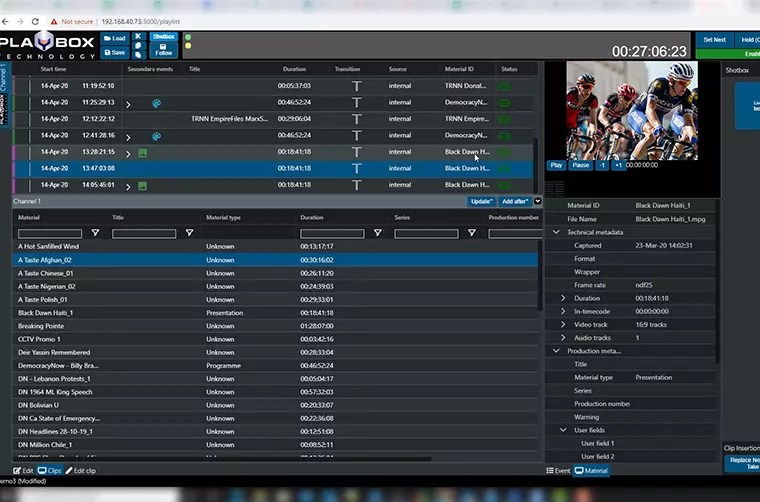
Celebro Play, our media orchestration platform, offers Extend, Hybrid, and Standalone deployment models specifically so that adopting it doesn’t require abandoning existing infrastructure or a managed services relationship you already have — relevant whether you’re a broadcaster operating playout in-house or evaluating the technology layer underneath a managed arrangement. All critical operations — playlist changes, failover, workflow approvals — require operator confirmation and are logged for full audit traceability, directly addressing the Ofcom-style compliance requirement in Section 9.
For the underlying playout engine, AirBox provides the scheduling depth and automated conflict resolution that dual-site, resilient operation depends on, while Cosmos extends that same capability across cloud and hybrid deployments — relevant to the SDI/IP/cloud mix most established UK broadcasters are actually running.
Where we’d genuinely encourage direct comparison: if your organisation has decided that a fully managed playout service is the right path (Section 2), Red Bee Media and Arqiva have deep, UK-specific track records worth evaluating directly rather than a software platform alone. And if your operation has significant existing investment in one of the Category A vendors’ broader plant ecosystems, that existing relationship is a legitimate factor to weigh against a vendor-agnostic alternative like PlayBox.
14. Conclusion
For a UK national broadcaster, the right orchestration choice starts with a decision most other markets don’t have to make quite so explicitly: build and operate the technology yourselves, or hand the function to a managed service provider with deep UK regulatory and distribution expertise. Whichever path you take, the criteria that actually matter — access services support, tested dual-site resilience, Ofcom-satisfying compliance logging, and genuine DTT distribution integration — are specific to operating in this market, not generic broadcast requirements with “UK” added to the title.
If you’d like to talk through where PlayBox’s platform fits, whether alongside an in-house team or as the technology layer within a managed arrangement, get in touch with PlayBox Technology for a demo of Celebro Play, AirBox, or Cosmos.
